Hello, Thank you for visiting my blog. I would greatly appreciate contributions in terms of new thoughts & concepts towards this blog. Please Click on the links above to access the different sections of the blog. If you want some perspective on how you or your company needs to enhance their Sales or Client Management Capabilities, please email me (Shubhanjan Saha) at shubhanjan.saha@gmail.com & do not forget to subscribe to my posts ! :-) .

Click here to go to Dealsupportguy.com

Sunday, June 1, 2014

Opportunity Assessment Framework


There is a need to effectively assess opportunities so that they can be managed effectively, in order to do that we had to often classify an opportunity into three categories.

1. Company Business Goals - This is a category that evaluates if the opportunity builds brand awareness, increases revenues, lower operational investments or helps us in cross selling across the divisions
2. Impact on the Client & the Software/Services Industry : It usually covers factors associated with customer satisfaction and our industry standing to increase our market share
3. Competitive Stance : This evaluates if this opportunity is a medium for us to enter the market/leapfrog/or attain par with competition. A second point should assess the window of the opportunity that is available for us to exploit 


With all this you could also add framework aspects which contribute towards customer loyalty, Supply or demand constraints, your team's delivery record, or any other aspect that you may find useful to your particular organization.

 If you want some perspective on how you or your company needs to enhance their Sales/Client Management Capabilities, please email me at shubhanjan.saha@gmail.com

Monday, March 31, 2014

Areas where Business Value can be quantified


Business value is a critical component that needs to be projected effectively, in order to do that I have gone ahead and compiled a list of areas where they can be explored, Although some of them can be a little tricky to quantify, but then this is something that needs to be discussed with your marketing / Solutions/ Finance/ Leadership  teams to see if they have any data to support the claims.

1.    Corporate
  • Results oriented  company
  • Brand Differential
  • Innovative Products
  • Error free products
  • Ease of Doing Business
 2.    Marketing
  • Brand Differentiation
  • Product Solutions
  • Strong Distributor’s
  • Strategic Alliances
  • Exceptional Service
3.    Operations
  • Agile Capacity
  • Low cost Products
  • Error free Products
  • Supply Chain
  • Ease of Doing Business
4.    Information Systems
  • E-Commerce Capability
  • Project Management
  • Service and Reliability
  • Supply Chain
  • Flexible Systems
5.    Human Resources
  • Results oriented  company
  • Leadership Depth
  • Personal Growth
  • HR Expertise
  • People Capacity
6.    Finance
  • Streamlined Finance
  • Fiscal Insight
  • Analytic Capability
  • Financial Information
  • Cost Management
If you want some perspective on how you or your company needs to enhance their Sales/Client Management Capabilities, please email me at shubhanjan.saha@gmail.com


Tuesday, February 18, 2014

Software Demonstration Stages (Terms)

Although this is something that appears to quite a basic accepted practice across all software & service companies, but I am just mentioning this since I found out that a ot of Sales reps are not aware of this so let's get that cleared !

The way we see it, there are three categories or levels of demos (or "software experiences" that go by the name of demo):

Stage 1: The overview : This is the stage where you educate the prospect by providing him with information about what your company does and and what your software or service solves. The delivery mechanism usually involves power-point presentation and videos. Here your prospects don't actually operate the software — they just watch it !!

Stage 2: The Details : This stage involves in showing your prospect detailed functionality of your software. This is sometimes unguided (e.g., you let the user download a sample or presentation), and this is sometimes carefully scripted and managed (e.g., an in-person or Web-based step-by-step walk-through of your product).

Stage 3: The Trial Version (Optional) : Now some companies may offer this sort, where a sample version is released or a standardized version is released to the prospect so that they might experience, The client usually pays for the consulting and installation, However you may want to forgo the license fees in anticipation of a larger roll-out. Usually this is the the stage where your company plays the coach 

If you want some perspective on how you or your company needs to enhance their Sales/Client Management Capabilities, please email me at shubhanjan.saha@gmail.com

Saturday, February 1, 2014

Due Diligence Analysis Model

Before any sale, we should ensure that steps should be taken to secure the best value in any deal. This is a vital element before contemplating any transaction. We usually tend to use very basic due diligence models which allow us to assess the potential clients in terms of their financial health and how they may contribute towards our growth

Usually while designing a Due Diligence scorecard we take into account the following factors
1. Financial Performance
2. Brand Value
3. Business Conditions
4. Prospects for the Future
5. Client Organization
6. Competitive Environment
7. Quality of Assets
8. Structure of purchase transaction
9. Other Critical Risks

These 9 factors can be subdivided into many more factors which can be assigned specific weight-ages which would contribute to the final rating that can be assigned to the client

All this is based upon financial & Legal documentation, Insurance Policies,Research, Press Releases, Intellectual properties & Strategic Agreements


If you want some perspective on how you or your company needs to enhance their Sales/Client Management Capabilities, please email me at shubhanjan.saha@gmail.com

Saturday, January 18, 2014

Activity Based Cost Model (ABC Model)


Often to understand and figure out answers to questions like :
1. What is the true costs of the services we are providing to our clients?
2. How much should we charge clients for the cost of our services?
3. What are low and high priority activities in terms of funding

I usually tend to prefer using the ABC model, as the this type of model helps us allocate costs in an effective manner. This model is based on the principle that activities incur costs through the consumption of resources.

This type of modeling uses a two step process to allocate costs:

Step 1: You have to pull actual costs (what was spent) per the most reliable source, such as the General Ledger. Once you have identified the actual costs, then you have to determine how to allocate all of these costs (resources) to the activities that are performed by the department (or what-ever domain you are building the model towards). Labor costs are typically allocated by looking at the percentage of time people spend on various activities.

Step 2: Once you understand the costs by activities, then you need to allocate these costs to your cost objects (such as the different service lines you perform for customers). For example, the number of help desk tickets processed is an output driver to allocate costs from the help desk activity to help desk support costs.


If you want some perspective on how you or  your company needs to enhance their Sales/Client Management Capabilities, please email me at shubhanjan.saha@gmail.com

Wednesday, November 27, 2013

Sales Automation


Field effectiveness can be enhanced by focusing on automating certain tasks which in most cases I have found to be a drain on salesperson’s resources. I have seen that time spent on these activities often take up valuable time leading to salespeople getting frustrated, such tools would increase selling productivity and, at the same time, lower selling costs. 

I have gone ahead and identified certain tasks that help us in achieving the main objective. I will focus on tools that support such tasks by giving screenshots and samples in some of my future articles (also when I have more time to write in detail on that …;-))).

Some of the tasks that can be easily automated are:

• Reducing the amount of time a salesperson devotes to administrative tasks such as the preparation of call reports.
• Tracking sales leads.
• Managing time and territory
• Developing proposals and persuasive presentations


If you want some perspective on how you or  your company needs to enhance their Sales/Client Management Capabilities, please email me at shubhanjan.saha@gmail.com
Wednesday, November 20, 2013

Campaign ROI Reporting

Sales Leaders are usually under a lot of pressure to justify their marketing expenditures. Knowing that a campaign generated a certain number of leads is interesting but it doesn't help justify the marketing campaign expense therefore I have noticed that knowing a Campaign ROI makes a difference as it helps him understand if the Campaign is giving results or not!!. Usually first you have to identify the key success criteria that you want to focus on, for eg :

1. Total revenue,
2. Upsell revenue,
3. Percentage increase in revenue / percentage of new customers.

Then as you complete your marketing campaigns you'll be able to score the success of each campaign against your predefined success criteria using metrics that involve the following different stages:

•    Marketing deliverable
•    Prospect response
•    Lead capture
•    Lead qualification
•    Lead acceptance
•    Conversion.

Just make sure that you establish a success criterion for each of the steps in your marketing process.

All this while simultaneously calculating your campaigns' performance by return on investment (ROI) and average cost. For each campaign in the report: ROI, which is expressed as a percentage,it is usually calculated as the net gain (Total Value Won Opportunities - Actual Cost) divided by the Actual Cost.

If you want some perspective on how you or  your company needs to enhance their Sales/Client Management Capabilities, please email me at shubhanjan.saha@gmail.com

Tuesday, November 19, 2013

Components of a Project Feasibility report for a deal

Most of the Project Feasibility reports that I have created for the various deals that I have supported have used the following components mentioned below , which have sufficiently covered all aspects of the requirements of the prospective client in one report.

1. Cost of Implementation: Includes total costs all broken down into the fixed. Variable and other components – Operational Costs,  Projected Revenue & Projected Viability i.e. (Surplus  / Deficit)
2. Cost Derivation Method: Includes basic details and  also some extra details like if an escalation is required and what is the % increase required.
3. Value Assessment: Has details of the % of the returns it will give i.e  ROI, Also should have details if the cost & revenue is optimistic/moderate/conservative
4. Job Creation: An important aspect on how many jobs will be created (please remove if performance enhancing software)
5. Demand/Need for Software : Quite an essential component
6. Appropriateness Assessment: Is the project considered appropriate in terms of project type, cost and beneficiary need, as a seller for us it is usually a big “YES”.with all the details. ;-)
7. Sustainability Assessment :  Should include details on sustainability of the project

If you want some perspective on how you or  your company needs to enhance their Sales/Client Management Capabilities, please email me at shubhanjan.saha@gmail.com

Friday, May 10, 2013

Sales Pay-out Modeling

Just like the design process the modeling is also based upon the goals the company wants to achieve. For eg : What is the payout under various situations: below budget, at budget and above budget? ,Is the plan capped or uncapped?, Does the commission rate increase after the company reaches various performance levels?

Payout modeling is intended to ward off the effects of ‘unintended consequences.” You do not want to design a plan to reward a specific performance outcome only to have people act in a totally different manner.

Once things are cleared you can then refer to the basic engineering of the model which reflects in the screenshot below


If you want some perspective on how you or  your company needs to enhance their Sales/Client Management Capabilities, please email me at shubhanjan.saha@gmail.com

Friday, May 3, 2013

Sales Incentive Plan Effectiveness Checklist

As a Business Analyst one of my tasks was to support & design the Incentive plan for the Sales /Client management population I was advised to keep the following checklist in mind while providing support to the design project. This check list can also help identify issues and problems with the existing sales compensation plan.

  1. The sales incentive plan must support the marketing strategy and the long-term continuity of the sales force.
  2. If the Return on Investment is negative or marginal the program should be reevaluated.
  3. Tactical issues usually revolve around avoiding the following:
  • Over or underpaying the sales force
  • Ignoring new business development
  • Resisting management and “doing my own thing”
  • Gaming the goal-setting process

The checklist indicates issues & problems with the incentive plan that need further analysis before a new plan can be modeled and then effectively implemented.
If you want some perspective on how you or  your company needs to enhance their Sales/Client Management Capabilities, please email me at shubhanjan.saha@gmail.com

Thursday, April 18, 2013

Sales Incentive Plan Design Process

I have found that most of the design process revolves around some specific goals like increasing revenue, increase retention, increase in market share etc. etc.. , so the design process usually are based upon the goals and the targets that the leadership want to achieve.

The  usual Sales Compensation  plan design process goes as follows

Step 1 : Evaluate Business Economic Value Drivers
Step 2 : Analyze Current Plan Effectiveness
Step 3 Part A. Determine Pay Strategy
Step 3. Part B Plan Design
Step 4. Payout Modeling
Step 5 Administrative Guidelines and Communication

If you want some perspective on how you or  your company needs to enhance their Sales/Client Management Capabilities, please email me at shubhanjan.saha@gmail.com

Wednesday, April 10, 2013

Best Practices: Designing a Sales/Solution Process Map

As a Consultant I have often found it easier to help a client when I understand their Sales/Solution Delivery process better, to do this I usually start off with a process map which helps me in analyzing my clients strengths and weaknesses so that I may be able to project them in manner that would be beneficial for them. I have mentioned some principles that help me guide through the process.

Common Mistakes when doing process Mapping
1.   Don’t start with a detailed map as you run the risk of losing track of the big picture
2.   Normally analysts start with focusing  on the client, instead Focus on the Seller as we are are doing a sales map and not a satisfaction survey
3.   Initially start the exercise by mapping without showing how the results will be measured
4.   Don’t go about copying other departments sales maps because most of the times they don’t apply to you

Principles that provide you with better insights
1.    Foreground goals in organizing your process map
2.    Determine how to create value for your client throughout the process
3.    Define and project the map tools, skills & performance metrics along with the process
4.    Engage your people in the process map to define problems and solutions

If you want some perspective on how you or  your company needs to enhance their Sales/Client Management Capabilities, please email me at shubhanjan.saha@gmail.com

Thursday, March 21, 2013

Projecting Budget vs. Forecast vs. Rolling Forecast

I should begin by advising that many companies usually have different takes on how do the measure or analyze their budgeting and forecasting, and in my usual vein I start of with my usual advice on the fact that they typically need both a budget and a forecast to manage your company.  They all have different purposes.  In the budgeting process, many executives focus almost exclusively on the income statement.  Usually Revenues are the primary concern, as if increased revenues will solve all the issues so Management decisions that affect the balance sheet accounts can have a greater impact on the company than revenue increases.
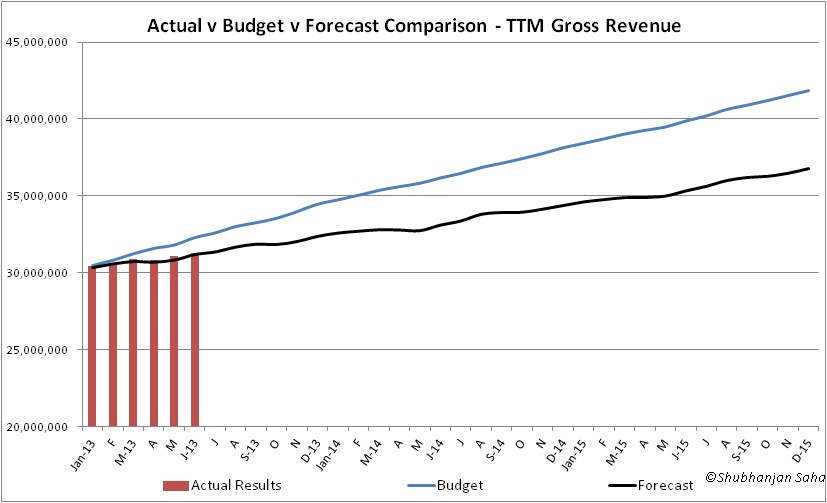
 The Rolling forecast takes the initial 36 month forecast and updates the projections at the end of each quarter.  In the end I usually show them what I have in my mind which is what I have attached below.

I have attached a chart that we used which pits Actual vs budget Vs forecast which we used to often analyze our performance


If you want some perspective on how you or  your company needs to enhance their Sales/Client Management Capabilities, please email me at shubhanjan.saha@gmail.com

Friday, March 1, 2013

Factors affecting Sales Forecasting

As an Field Effectiveness Analyst I have often been asked to keep track of certain factors that might affect the sales, usually the list is endless, but I have managed to narrow it down to some of the most obvious basic reasons

•    Number of sales reps
•    Number of working days
•    Advertising expenditures
•    Product pricing; customer terms
•    Currency exchange rates
•    Appointments set
•    Number of leads generated, outbound phone calls completed
•    Conversion rates for: Contacts to Prospects to Customers
•    Web hits, Google rankings, SEO metrics
•    Economic conditions (local, SMSA, state, region, country)

Like I said earlier the list does not end. Every company is different, and some factors could change

 If you want some perspective on how you or  your company needs to enhance their Sales/Client Management Capabilities, please email me at shubhanjan.saha@gmail.com

Friday, February 22, 2013

Where do you look to squeeze in the Benefits ??

Often I have had salespeople pestering me to project Productivity, costs & Revenue on the presentation, as a result I have identified some key points which help me identify & project the benefits in the product / solution.

• Increasing productivity
− Reducing the number of tasks
− Reducing time per task
− Reducing skill level needed
− Increasing resource utilization
− Reducing need to add headcount
− Reassigning headcount to more productive tasks

• Reducing costs
− Reducing overhead expenses
− Avoiding planned purchases
− Improving asset utilization

• Generating revenue
− Creating new revenue sources
− Reducing time to market
− Reducing lost revenue such as downtime avoidance
− Optimizing current opportunities

If you want some perspective on how you or  your company needs to enhance their Sales/Client Management Capabilities, please email me at shubhanjan.saha@gmail.com

Wednesday, February 6, 2013

Sales Dashboard Design Process

The dashboard design process usually consists of a metric selection, design and implementation steps. Each of these steps involve some basic principles outlined below.

Metric Selection

• Supports stated objectives, strategies and goals
• Can be directly impacted by sales management
• Can be measured in a cost effective and timely fashion
• Reflects one of the four key dimensions of sales performance (readiness, productivity, efficiency and effectiveness)
• Enables performance benchmarking with industry competitors and best-in-class companies

Dashboard Design Principles

• Reflects senior management priorities
• Balances internal and external metrics
• Includes measures of past performance and indicators of future performance
• Minimizes the number of metrics in order to facilitate management interpretation

The actual design process is outlined below along with the detailed steps involved:

Metric Selection
• Identify existing and potential metrics by corporate performance perspective (interview process)
• Categorize metrics into four dimensions of sales performance (efficiency, effectiveness, productivity and readiness) and eliminate unclassifiable metrics
• Create preliminary scorecard matrix that combines business perspectives with sales performance dimensions
• Review scorecard matrix for completeness and add metrics based on experience

Dashboard Design
• Eliminate metrics that cannot be measured or are too costly to measure
• Eliminate metrics that cannot be significantly impacted by sales management
• Prioritize metrics based on alignment with stated strategy and goals
• Select top metric per cell in scorecard matrix based on alternative approaches
• Evaluate alternative scorecards and select most appropriate metrics

Implementation

• Assign metric accountability
• Determine performance targets
• Obtain available benchmark data
• Determine monitoring, interpretation and feedback procedures and guidelines
• Develop corrective action review process

If you want some perspective on how you or  your company needs to enhance their Sales/Client Management Capabilities, please email me at shubhanjan.saha@gmail.com


Saturday, January 26, 2013

Some Prospect Qualifying Questions

Often knowing which questions to ask from a prospect and what specific answers to look out for is the key to qualifying prospects and getting them to the next stage of the sales cycle As usually it is critical for the Sales folks to ask the right qualifying questions when first talking to prospects. As I have noticed that too often, sales reps are so focused on presenting their sales pitch that they end up doing way too much talking and not nearly enough listening. I have listed some questions I believe are to be best practices for qualifying prospects.

Introductory Questions:

•    What are the main objectives of your company?
•    Are there any specific products/services/solutions are you looking for?
•    What are your immediate needs?
•    How familiar are you with our company?
•    Have you had any experience with our products/services?
•    How familiar are you with our new products?
•    Whose products/services/solutions are you presently using?

Qualifying Questions:

•    Tell me more about your specific situation.
•    What are your top three criteria for buying?
•    What qualities are you looking for in (product/service/solutions)?
•    What do you like most about the products you are presently using?
•    What would you like to change?
•    What specific features are you looking for?
•    What are your major concerns?
•    Are you part of a buying team? If so, what specific information are you looking for?

Demonstrating Questions:

•    What do you think of this product’s performance?
•    How does it compare to your present product?
•    How do you feel it will stand up to your specific needs?
•    What do you think about incorporating our products/services/solutions into your specific strategy?
•    What specific concerns do you have regarding our products/services/doing business with us?
•    How do you plan on using this in your organization/department?
•    What do you see that you particularly like?

Closing Questions:

•    Who else other than yourself is involved in the decision-making process?
•    When are you looking to make a purchasing decision?
•    What are your budget constraints?
•    Who else should we be contacting?
•    What would you like to see as the next step?
•    How do you propose we get started?
•    How soon would you like our sales representative to contact you?
•    What is your time frame for making a decision?
•    What else would be important for me to know?
•    What else would be important for you to know?

If you want some perspective on how you or  your company needs to enhance their Sales/Client Management Capabilities, please email me at shubhanjan.saha@gmail.com

Friday, January 18, 2013

Twelve Essential Attributes of Effective KPIs

Often I have been asked to choose or recommend KPI's that would portray the performance of a project, I have usually chosen metrics based upon the following characteristics

1. Aligned. KPIs are always aligned with corporate strategy and objectives.
2. Owned. Every KPI is “owned” by an individual or group on the business side who is accountable for its outcome.
3. Predictive. KPIs measure drivers of business value. Thus, they are “leading” indicators of performance desired by the organization.
4. Actionable. KPIs are populated with timely, actionable data so users can intervene to improve performance before it is too late.
5. Few in number. KPIs should focus users on a few high-value tasks, not scatter their attention and energy on too many things.
6. Easy to understand. KPIs should be straightforward and easy to understand, not based on complex indexes that users do not know how to influence directly.
7. Balanced and linked. KPIs should balance and reinforce each other, not undermine each other and suboptimize processes.
8. Trigger changes. The act of measuring a KPI should trigger a chain reaction of positive changes in the organization, especially when it is monitored by the CEO.
9. Standardized. KPIs are based on standard definitions, rules, and calculations so they can be integrated across dashboards throughout the organization.
10. Context driven. KPIs put performance in context by applying targets and thresholds to performance so users can gauge their progress over time.
11. Reinforced with incentives. Organizations can magnify the impact of KPIs by attaching compensation or incentives to them. However, they should do this cautiously, applying incentives only to well-understood and stable KPIs.
12. Relevant. KPIs gradually lose their impact over time, so they must be periodically reviewed and refreshed.

If you want some perspective on how you or  your company needs to enhance their Sales/Client Management Capabilities, please email me at shubhanjan.saha@gmail.com

I recommend reading Wayne W. Eckerson's - Performance Dashboards: Measuring, Monitoring and Managing Your Business, Hoboken, NJ: John Wiley & Sons Publishers

Saturday, December 8, 2012

Sales Ranking Reports

To increase salesperson competitiveness, we in sales effectiveness teams often use what we call is a sales ranking report which can be produced monthly or weekly and distributed amongst the salespeople to give them an idea where they stand.  As they usually help in controlling the sales pipeline  while simultaneously helping in the auditing process  when tallying the numbers with information provided by the accounts receivables department to analyze the variance in the margins and also motivate the team.

We can also modify the report to portray details of a particular region, sales director, or a particular product using pivot tables

Although as a note of warning I should mention that  I know enough about numbers and presentations to tell you that numbers can be manipulated to deceive. However, that’s not the case with sales ranking reports. A sales ranking report must be an honest assessment of overall sales attainment.

These are the few metrics that we usually include in our reports
  • MTD $ Quota
  • MTD $ Sales Attainment
  • MTD % of Quota
  • MTD $ Forecast
  • MTD % of Forecast
  • YTD % of Quota
  • Salesperson Ranking
 
If you want some perspective on how you or  your company needs to enhance their Sales/Client Management Capabilities, please email me at shubhanjan.saha@gmail.com

Friday, December 7, 2012

Basic Quantitative Analysis Techniques

To project data in my reports I have often used the below mentioned techniques to elicit information out of my Point of Contacts (POC), please be advised that the most important thing in this whole exercise is establishing RAPPORT and promoting your own CREDIBILITYwith your POC’s rather than just pumping them for answers.

  1. Questionnaires:  Questionnaires are among the range of techniques that a Consultant can use to elicit requirements or gather other information, or to validate with a wider group of people the information already gained from smaller groups by using, for example, interview calls or Conference calls
  2. Sampling :  Sampling is one of the techniques that can be used to obtain quantitative data during a business analysis assignment – particularly data about how people spend their time. This is valuable because it enables the Consultant to understand where the real problems and issue lie, and it also provides input to the business case for change.
  3. Document analysis : Document analysis is the systematic examination of data sources, usually forms, but also screen layouts and reports if there is an existing system, to analyze the data requirements of a proposed computerized information system.
  4. Mind maps :   The basic concept of a mind map as a visual representation of a set of ideas, words things or tasks. They can be used in several situations, for note taking during interviews or other meetings and of-course in workshops
  5. Context diagram : Its just an extend form of a mind map, the essential idea of a context diagram is that it shows a proposed IT system in relation to the wider world – to the people and other systems with which it must interface. The system itself is regarded as a “Black-box” with things going on within it.
 If you want some perspective on how you or  your company needs to enhance their Sales/Client Management Capabilities, please email me at shubhanjan.saha@gmail.com

Thursday, December 6, 2012

Requirements Projection: MoSCoW prioritization Analysis

I have initially faced problems with identifying & explaining the prioritization of requirements for the project, so I have often used the MoSCoW rules which have helped me to analyze and project the requirements for the prospective client

Must have (Mo): Usually such requirements are classified as essential, without which the deliverable automatically gets termed as unworkable and useless. Their delivery at the end of the appropriate timebox is guaranteed. If any one of these ‘Must haves’ is not ready then nothing can be released: if it could be, then they were not really ‘Must haves’ in the first place.

Should have(S): These are important requirements for which there is a work-around in the short term, or where expectations can be managed. They are things that would have normally have been classified as ‘Must haves’ in a less time-constrained situation, but the deliverable will still be useful and usable without them initially. They would, however, be expected to be delivered soon afterwards, since the work-around is not usually a long term solution.

Could have(Co): These are requirements that can more easily be left out at this point. They may well be included in this delivery if their inclusion is easy to achieve without jeopardizing the delivery of the ‘Must haves’ and ‘Should haves’. A ‘Could have’ may be differentiated from a ‘Should have’ by considering the degree of pain caused by its non-inclusion in terms of business value or number of people affected.

Want to have but won’t have this time round (W)): This refers to those valuable requirements that can wait until later. It is often useful to keep these in the initial priority list, since, although they are not due for delivery yet, knowledge that they will be coming later may influence design decisions and the approach taken to the planning of subsequent deliveries

  If you want some perspective on how you or  your company needs to enhance their Sales/Client Management Capabilities, please email me at shubhanjan.saha@gmail.com

Wednesday, December 5, 2012

Time Series Analysis Factors

The most common way to forecast sales is using the Time Series Analysis which is actually prepared on the basis of past sales. By utilizing a time series analysis the business leader is able to keep his sales teams more efficient by helping in :

•    Smoothing out the erratic factors (e.g. by using a moving average)
•    Adjust for seasonal variation
•    Identify and estimate the effect of specific marketing responses

A Time series analysis covers  four components which I have observed in majority of the scenarios that I have encountered:
  1. Trending factors: This pertains to the basic judgment of the sales are going up, down or just flattening.
  2. Seasonal or cyclical factors : I have noticed that most sales are affected by swings in general economic activity or seasons (e.g. : Majority of the B2B sales go down during the End of year in the western markets due to the holidays) Usually such seasonal and cyclical factors occur in a regular pattern.
  3. Change in Marketing Strategy : This component could be taken into consideration as something that includes the results of particular measures that have been taken to increase sales
  4. Unexpected Events: This could include various disturbances like the start of the recession, or industry collapse, they can be easily identified by isolating from the past data , so as to help in projecting a more accurate sales forecast
If you want some perspective on how you or  your company needs to enhance their Sales/Client Management Capabilities, please email me at shubhanjan.saha@gmail.com

Tuesday, December 4, 2012

Goal & Target setting

Goal & Target setting is a important and crucial aspect that helps the organization to determine its performance, I have mentioned some critical points that have helped me in deciding or setting goals

Annual Target - This is the target that you have decided that you need to meet in order for to be considered successful or profitable (usually set by the finance teams).

Average Monthly leads - On average how many leads per month are are being generated from your target markets. It is important to determine the number of leads for each geographic region for your target market..

Win Rate - This is the rate at which your sales rep can convert a lead to a client. As calculating this win rate is usually necessary and can be achieved by constantly tracking and monitoring each lead in the pipeline with their chances of being successful (I have written a separate article on pipeline analysis for this please refer to that), and is one of the most important performance indicators that you should monitor.

Average Value Per Sale - This is the average value of each sale that is converted from a lead. If you are not selling products then then usually this is the estimated value of each conversion to your company.

Monthly Growth - Assuming that you are seeking to improve your current position. What is the monthly growth you expect from your current operations. This should be a realistic figure that can be achieved.

If you want some perspective on how you or  your company needs to enhance their Sales/Client Management Capabilities, please email me at shubhanjan.saha@gmail.com

Monday, December 3, 2012

TCO Summary & Components

(Please be advised that this is as per my experience with  the Software/Services industry components could vary according to product or marketing strategy)

TCO has now become an industry standard for measuring and managing project-related costs over time. It looks beyond a one-year budget cycle. It showcases the  changes as an organization while it finalizes its purchasing contracts, determines feasibility of various components of the project, and adapts to new opportunities (in services or technologies that become available, for example). The “final” TCO therefore evolves as planning and discussions progress.

A thorough TCO analysis engages all stakeholders, not only to gain their support and perspectives
concerning  the service  but also to ensure that the final TCO report accurately reflects all costs, benefits, goals and expectations

The TCO attempts to estimate all costs related to the ownership, management, support and usage of the components comprising the project. The Indirect costs are a key component of the TCO because,
as mentioned, many costs cross organizational boundaries and reside outside of the budget of the project sponsor. 

Direct and indirect costs might include:
  • Capital purchases
  • Hardware
  • Software
  • Implementation
  • System Downtime
  • Management and Administration
  • Research of vendors & contracts
  • Service & System Downtime
  • Support & training
  • Upgrades & related re-training
  • Indirect labor if any
  • Subscriptions
  • System integration
  • Maintenance
If you want some perspective on how you or  your company needs to enhance their Sales/Client Management Capabilities, please email me at shubhanjan.saha@gmail.com

Sunday, December 2, 2012

Sales Pipeline Analysis Summary

Sales pipeline analysis usually focuses on the continual tracking and study of sales opportunities from
raw lead to closed sale.This in turn can be effectively utilized by Sales managers to monitor key performance indicators to ensure that the various  marketing activities and efforts are generating the number, quality and flow of leads necessary to meet sales targets and ensure that sales cycles are progressing towards closure.

These Sales pipeline reports show the status and value of the various deals that are currently in the pipeline and probability-weighted forecasts. They play an important role by allowing the sales teams to effectively drill in to particular deal terms and conditions, and update material deal terms as the negotiations occur.

Usually many of the Business-intelligence enabled sales pipeline reporting not only generates and delivers these reports on a regular basis, but also allows managers to uncover competitive trends and performance anomalies by region, product or customer segment.

If you want some perspective on how you or  your company needs to enhance their Sales/Client Management Capabilities, please email me at shubhanjan.saha@gmail.com

Saturday, December 1, 2012

Sales Performance Analysis Summary

Sales Performance Analysis provides some valuable insight into expected and actual achievement of the
Sales representatives along with the hierarchy of the sales organization. As this empowers Executives and sales managers to view dashboards summarizing sales representatives quota achievements, detailed reports on sales representatives’ pipelines, and benchmark reports that compare sales representative performance.

Further Drilling in to pipeline detail can reveal factors contributing to the over- and under-performance of regions and/or representatives. Thus by constantly reviewing sales representative performance versus quota and bench-marked relative to relevant peers, sales management can proactively develop performance improvement plans for under-performing sales representatives and provide appropriate motivational recognition for top performers

This can be based upon the following Key Performance Indicators which I have explained in an earlier article with the help of some presentation decks


If you want some perspective on how you or  your company needs to enhance their Sales/Client Management Capabilities, please email me at shubhanjan.saha@gmail.com

Friday, November 30, 2012

Tracking "Discounting" in Sales

We in Sales management have often faced a common problem of tracking and managing “Discount’s”.They are critical contributors to the Cost component in the Financial Statement.,as identification of such components, would lead to effective decision making and improve our understanding of the market, by helping us identify certain trends that help predict and control our pipeline by helping us identify the extent of discounting that needs to be provided to ensure the profitability of the company.

In addition to this I have noticed that the discount rates typically applied to different types of companies show significant differences when dealing with the Services/ Solutions industry:

Fresh Start-ups: 55% – 100%
Small Business: 40 – 60%
Middle Market: 30 – 50%
Multinational: 10 – 25%

I have also gone ahead and categorized the types of Discounts and allowances that are offered to clients for easy classification and analysis (please note this is primarily aimed at the Services/Solutions sector)

Discounts involving Payment
#Deal Discount: This is a discount when you offer when clients make a payment in full
#Partial payment discount: This is a discount when you offer when clients make a partial payment
#Seasonal discount: This is a discount when you offer based upon certain season this is quite rare in the services/solutions industry and is usually offered to B2C companies that do seasonal business.

Discounts involving quantity
#
Total quantity discount: This is a discount when you offer when clients make a bulk orders
#Partial quantity discount: This is a discount when you offer when clients make small or partial orders.


If you want some perspective on how you or  your company needs to enhance their Sales/Client Management Capabilities, please email me at shubhanjan.saha@gmail.com

Thursday, November 29, 2012

Metrics Matrix


To Metric matrix tool is an effective tool that may be created in order to identify, classify and design an effective sales projection dashboard, this is actually a part of a methodology to bring in a more focused business perspective to bring in a more heuristic approach to understanding sales performance which would help in aligning the business perspective with the sales performance for effective sales measurement.

This matrix combines the business perspectives along the horizontal axis with sales performance dimensions along the vertical axis. Each metric is placed in the matrix based on its most appropriate classification with respect to these dimensions.

This tool has the following benefits:

• Creates a framework around the metrics selection process
• Balances business perspectives and sales performance views
• Provides a systematic approach
• Facilitates prioritization
• Allows identification of particular areas of emphasis
• Highlights areas with no metric coverage

Sample Matrix


If you want some perspective on how you or  your company needs to enhance their Sales/Client Management Capabilities, please email me at shubhanjan.saha@gmail.com